The U.S. Federal Reserve has raised interest rates again, and the effect of that decision is being felt well beyond America. A stronger U.S. dollar, pressure on the Indian rupee, crude oil remaining above $100 per barrel, changing foreign-investor flows and expectations around future RBI policy can all influence Indian stocks, mutual funds, borrowing costs and even everyday household expenses.
For an ordinary investor, these may appear to be completely different developments. In reality, they are connected. In this EquiRise Capital News & Interpretation, we explain the Fed rate hike impact on India in simple language — what happened, why the Federal Reserve raised rates, why the rupee is under pressure, how crude oil enters the picture, which sectors may be affected, what it means for mutual-fund investors and what investors should monitor next.
1. Fed Rate Hike 2026: What Happened?
On 16 September 2026, the U.S. Federal Reserve increased its key policy rate by 0.25 percentage point, taking the federal-funds target range to 3.75%–4.00%. The decision was unanimous, and the Fed said inflation remains elevated and that the move is intended to support a return toward its long-term 2% inflation objective. Federal Reserve
The important point is that markets are not reacting only to this one rate hike. Investors are also trying to understand whether the United States has entered a broader period of higher interest rates. Reuters reported that the rate increase strengthened the dollar and increased expectations that further tightening could follow. Reuters
At roughly the same time, the Indian rupee remained close to ₹96 per U.S. dollar, Brent crude remained above $100 per barrel, and investors continued to monitor foreign flows and the possibility of tighter financial conditions globally. These developments matter because they can influence Indian inflation, RBI policy, company profits and ultimately investor returns. Reuters
2. What Is the Federal Reserve Interest Rate?
The Federal Reserve, commonly called the Fed, is the central bank of the United States. In a broad sense, its role is comparable to the Reserve Bank of India in India. The Fed influences short-term interest rates in the U.S. financial system and uses monetary policy to balance inflation, employment and economic conditions.
When financial news says that the Fed raised rates by 25 basis points, it simply means interest rates increased by 0.25 percentage point. One hundred basis points equal one percentage point, so 25 basis points equal 0.25 percentage point.
That may appear to be a very small adjustment, but the United States sits at the centre of the global financial system. The U.S. dollar is used extensively for international trade and investment, while U.S. government securities are held by investors around the world. A small change in American interest rates can therefore influence very large amounts of global capital.
3. Why Did the U.S. Fed Raise Interest Rates?
The simple reason is that inflation remains higher than the Fed would like. In its September statement, the Federal Reserve said inflation remained elevated and that tighter policy was intended to support a return toward its 2% objective. Federal Reserve
Inflation simply means that the general prices of goods and services are increasing. If something that earlier cost ₹100 later costs ₹105, prices have risen. When inflation remains high for too long, people's purchasing power falls because the same amount of money buys fewer goods and services.
Central banks often respond by increasing interest rates. Higher rates generally make loans more expensive, reduce the attractiveness of borrowing and can slow spending. That can reduce demand and eventually help control inflation.
The present situation, however, is more complicated because energy prices and geopolitical disruptions are also adding to inflation concerns. Interest-rate increases can cool demand, but they cannot directly produce additional crude oil, reopen a shipping route or resolve a geopolitical conflict. That is why markets are debating how much additional tightening will actually be necessary. Reuters
4. How Does a Fed Rate Hike Affect India?
Imagine a global investor has ₹100 crore available to invest. That money can be invested in U.S. government securities, Indian bonds, Indian shares, European markets, gold or several other global assets.
India may offer attractive long-term growth, but investing in an emerging market also involves additional market and currency risk. When relatively safer U.S. assets begin offering higher returns, some global investors may reconsider how much additional risk they want to take elsewhere.
This does not mean every foreign investor immediately sells Indian investments after a Fed rate hike. However, the relative attractiveness of different markets changes. When large institutional investors adjust their allocations, that can affect foreign portfolio flows into and out of India.
5. What Is FII/FPI Selling and Why Does It Matter?
Foreign Portfolio Investors, commonly referred to as FPIs or FIIs, are overseas institutions that invest in Indian shares, bonds and other financial assets. They can include global mutual funds, pension funds, sovereign wealth funds, insurance companies and other institutional investors.
Suppose a foreign investor sells Indian shares and wants to take that money back to the United States. The rupees received from the sale may need to be converted into U.S. dollars. If large amounts of foreign capital leave India at the same time, demand for dollars can increase.
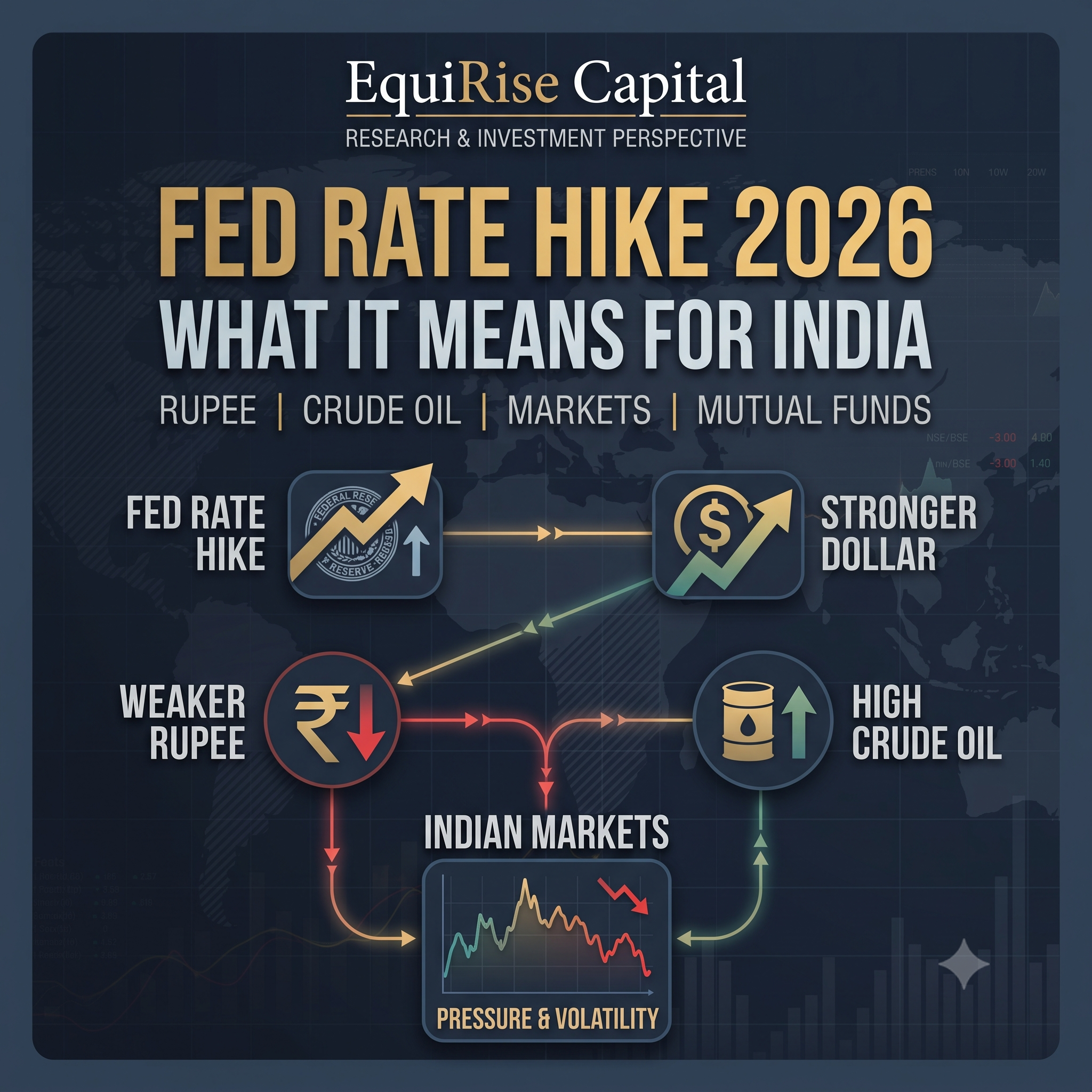
In simple terms, the chain can be understood like this: the Fed raises rates, U.S. assets become relatively more attractive, some investors reduce emerging-market exposure, capital moves out of countries such as India, demand for dollars rises and the rupee can come under pressure.
6. Why Is the Indian Rupee Under Pressure?
The Indian rupee has recently been trading very close to the ₹96-per-dollar level. Reuters reported that the currency had closed at ₹95.955 per dollar on 15 September and remained under pressure around the Fed decision. Reuters
There are several reasons for this pressure. Higher U.S. rates can strengthen demand for dollar assets. Foreign investment outflows can create additional demand for dollars, while India's large crude-oil import requirement adds another important factor.
India imports a substantial portion of the crude oil it consumes, and international crude transactions are largely priced in dollars. This means that if crude becomes more expensive while the dollar also becomes more expensive in rupee terms, India faces pressure from both directions.
7. How High Crude-Oil Prices Affect India
Brent crude remained above $100 per barrel on 17 September. Reuters reported Brent at about $104.59 per barrel, after prices had been even higher earlier in the week because of concerns about Middle East supply disruptions. Reuters
To understand the impact, suppose India needs to buy one barrel of crude oil. If that barrel costs $80, India needs $80. If the price rises to around $105, India needs substantially more dollars to buy exactly the same quantity of oil. If the rupee has also weakened against the dollar, the rupee cost rises even further.
That higher cost can spread through the economy. It can influence transportation, logistics, aviation, manufacturing inputs, chemicals, inflation and company margins. This is why crude-oil prices matter even to an investor who has never invested in an oil company.
8. What Is India's Trade Deficit?
India both imports and exports goods. When the value of imports is greater than the value of exports, the difference is called a trade deficit. Reuters reported India's August merchandise trade deficit at approximately $26.8 billion. Reuters
Higher crude-oil prices can increase India's import bill because the country has to spend more foreign currency on energy purchases. If India needs more dollars to pay for those imports, additional pressure can develop on the rupee.
The broader sequence is straightforward: higher oil prices increase the import bill, India requires more dollars, the rupee can weaken, imported goods become more expensive and inflation pressure can rise.
9. Where Does the RBI Come Into This?
The Reserve Bank of India has to balance inflation, economic growth, liquidity, banking-system conditions and currency stability. If high crude prices and a weaker rupee create additional inflation pressure, the RBI may have less flexibility to maintain an easy monetary-policy stance.
Reuters reported that recent inflation concerns had led some economists to bring forward expectations of a possible RBI rate increase. However, this is an important distinction: the Fed has already raised rates, while a future RBI rate increase remains an expectation until the RBI itself announces a policy decision. Reuters
The RBI can also participate in the currency market to reduce excessive volatility. Reuters reported that traders believed the RBI had recently intervened through state-run banks to support the rupee. Such intervention can smooth sharp movements, although it does not permanently fix the currency at one particular level. Reuters
10. What Happens If Interest Rates Rise in India?
Higher interest rates can eventually affect households, businesses and investors. Borrowing can become more expensive, particularly for floating-rate or newly issued loans. That can influence home loans, vehicle finance, business borrowing and working-capital loans.
For companies, higher borrowing costs can increase interest expenses. Businesses carrying large amounts of debt may have less money available for expansion, capital expenditure or acquisitions. Consumers can also become more cautious if EMIs and everyday expenses increase, which may reduce discretionary spending.
Fixed-income investors face a different situation. Higher interest rates can eventually make newly issued bonds or deposits more attractive, but existing longer-duration bonds may temporarily lose market value when rates rise.
11. Fed Rate Hike Impact on the Indian Stock Market
A common mistake is to assume that a Fed rate hike automatically means the Indian stock market must fall. In reality, the effect varies significantly across sectors and companies.
Banks and financial companies can experience mixed effects. Higher lending rates may help some lenders, but their own funding costs can rise, loan demand can weaken and financially vulnerable borrowers may face greater repayment pressure.
Highly indebted companies deserve particular attention because rising interest costs can directly reduce profits. During a higher-rate environment, investors should pay more attention to debt levels, interest coverage and cash-flow strength.
Consumer-facing businesses can also come under pressure if inflation and expensive borrowing reduce household spending. Purchases such as automobiles, appliances, property and other discretionary goods may be postponed when consumers feel financially stretched.
Indian IT companies present a more complex picture. A weaker rupee can help companies that earn substantial revenue in dollars because foreign earnings translate into more rupees. However, if higher U.S. interest rates weaken American corporate spending, technology budgets can also come under pressure. Reuters noted that Indian IT stocks were among the areas investors were watching following the Fed decision. Reuters
Oil-dependent industries such as aviation, logistics, paints, chemicals and certain manufacturing businesses may face higher input costs. Export-oriented businesses, on the other hand, can sometimes benefit from a weaker rupee, but currency movement alone is not enough to make a company attractive. Global demand, margins, balance-sheet quality and valuation still matter.
12. What Does the Fed Rate Hike Mean for Mutual-Fund Investors?
This is probably the most relevant section for ordinary investors. Someone may own a flexi-cap fund, large-cap fund, mid-cap fund, small-cap fund, international fund or debt fund and suddenly wonder whether a Fed rate increase means it is time to exit.
The answer is not necessarily. A Fed decision changes the broader economic environment, but it does not automatically destroy the long-term investment case of every company held by every mutual fund.
Instead, investors should understand what their fund actually owns. The relevant questions are whether the portfolio contains heavily indebted businesses, whether valuations are excessive, whether the fund is dependent on domestic consumption, whether exporters could benefit from currency movements, and whether the fund still matches the investor's time horizon and financial goal.
For SIP investors, falling markets can allow new instalments to purchase more units at lower NAVs. However, that logic should not be used blindly. A lower NAV is useful only when the underlying fund remains suitable. A market correction and poor fund quality are two different things.
13. How Can Rising Rates Affect Debt Mutual Funds?
Debt funds react differently from equity funds because bond prices and interest rates generally move in opposite directions.
Suppose an existing bond pays 7%, and then interest rates rise so that a similar new bond becomes available at 8%. A new investor would naturally prefer the 8% bond. Therefore, the market price of the older 7% bond may need to fall to remain competitive.
This is why longer-duration debt funds can experience short-term pressure when interest rates rise. Over time, however, debt funds may be able to reinvest money into newer securities carrying higher yields.
Therefore, rising rates can hurt existing bond prices in the short term while improving future reinvestment opportunities. Debt-fund investors should understand duration, credit quality and the fund's investment objective rather than looking only at past returns.
14. Short-Term Market Reaction vs Long-Term Structural Reality
The distinction between short-term reaction and long-term impact is extremely important. Markets can react immediately through foreign selling, currency weakness, higher bond yields, stock-market volatility and pressure on expensive or heavily indebted companies.
The longer-term outcome depends on what happens next. If inflation cools, crude-oil prices decline and geopolitical tensions ease, central banks may not need to tighten policy as aggressively. If inflation and energy prices remain elevated, the higher-rate environment can continue for longer.
Therefore, the most useful question is not simply, “Did the Fed raise rates?” The more important question is, “How long will this higher-rate environment continue, and what happens to inflation, crude oil and economic growth from here?”
15. What Could Change This Outlook?
Several developments could materially change the current picture. A significant decline in crude-oil prices would reduce pressure on India's import bill, inflation, the rupee and corporate input costs. A sustained decline in U.S. inflation could reduce the need for further Fed tightening.
Foreign capital could also return to India if Indian corporate earnings remain strong or valuations become attractive enough. Similarly, a more stable rupee could reduce concerns around imported inflation.
On the other hand, if high interest rates severely weaken economic growth, central banks may eventually have to reconsider how much further tightening is appropriate. This is why investors should not treat the current situation as a one-direction story.
16. What Should Indian Investors Track Next?
Instead of watching the Nifty every few minutes, investors can focus on a smaller number of meaningful indicators: Federal Reserve policy, U.S. inflation, Brent crude oil, USD/INR, foreign portfolio flows, Indian inflation, RBI policy and corporate earnings.
The next scheduled FOMC meeting is on 27–28 October 2026, so investors will closely watch whether the Fed follows the September increase with another move. Federal Reserve
For India, crude-oil prices and the rupee remain particularly important because both directly influence imported costs. Investors should also follow actual RBI policy announcements rather than assuming that market forecasts will necessarily become reality.
Ultimately, long-term stock-market performance has to be supported by business performance. Revenue growth, margins, debt, cash flow, order books and management guidance remain more important for long-term investing than one day's movement in an index.
17. EquiRise Capital Interpretation: What Should Investors Actually Do?
This is not a situation where every investor should rush to sell. It is also not a situation where investors should blindly buy everything simply because prices have fallen. A disciplined review is more useful than either panic or excitement.
Equity investors should examine debt, valuation, input costs, currency exposure and demand. Companies with excessive borrowing or weak cash flow become more vulnerable when money becomes expensive, while companies with strong balance sheets and sustainable earnings are generally better placed to handle difficult financial conditions.
Mutual-fund investors should ask their adviser two simple questions: “Is my fund falling because the overall market is weak, or is something specifically wrong with my fund?” and “Should I continue, increase, reduce or change my investment — and why?”
An investor does not need to understand every complicated financial term. But the investor should understand why the investment has fallen, whether the issue is market-wide or fund-specific, what action is appropriate and under what circumstances the investment strategy should be changed.
New investors should also remember that a falling price does not automatically make an investment cheap. A stock can fall significantly from an extremely expensive valuation and still remain expensive. Business quality, balance-sheet strength, earnings sustainability and valuation must be considered together.
For SIP investors, if the financial goal, time horizon, fund quality and personal cash-flow situation remain appropriate, short-term market volatility alone is generally not a reason to abandon a disciplined SIP. At the same time, no fund should be held forever without periodic review.
18. The Bigger Picture: How the Fed Decision Reaches an Indian Investor
The entire economic chain can be understood simply. High U.S. inflation encourages the Federal Reserve to raise interest rates. Higher U.S. rates can make dollar assets more attractive and strengthen the dollar. A stronger dollar can place pressure on the rupee, while expensive crude oil increases India's import costs.
Higher import costs can increase inflation pressure in India. That can reduce the RBI's flexibility to keep monetary policy easy. Higher borrowing costs can then influence consumer spending, business financing costs, corporate profits and market valuations.
That is how a policy decision made in Washington can eventually influence an Indian investor's SIP, stock portfolio, mutual funds, loan costs, business expenses and even the prices of everyday goods.
EquiRise Capital Takeaway
Do not react to the headline alone.
A Federal Reserve rate hike does not automatically mean that Indian equities have become bad investments. It does mean that the financial environment has become more demanding.
When money becomes more expensive globally, markets become less forgiving of excessive debt, unrealistic valuations, weak cash flows and speculative stories that are not supported by earnings.
In this environment, investors should give greater importance to business quality, cash flow, manageable debt, reasonable valuations, diversification and patience.
The six major indicators worth monitoring now are Federal Reserve policy, crude-oil prices, USD/INR, Indian inflation, RBI policy and corporate earnings.
If several of these factors begin improving together, conditions for Indian markets can improve significantly. If several continue deteriorating together, investors should be prepared for continued volatility.
The appropriate response is therefore neither panic nor blind optimism. Understand the economic chain, review what you own, ask the right questions and make decisions based on evidence rather than headlines.
Frequently Asked Questions
Does a Fed rate hike always make the Indian stock market fall?
No. A Fed rate hike can influence foreign flows, currencies, interest rates and valuations, but Indian markets are also driven by domestic economic growth, corporate earnings, valuations, liquidity and investor sentiment. Different sectors can also react very differently.
Why can the rupee weaken when the Fed raises interest rates?
Higher U.S. interest rates can make dollar-denominated assets relatively more attractive. If international capital moves toward U.S. assets, demand for dollars can rise and currencies such as the Indian rupee can face pressure. High crude-oil prices and foreign portfolio outflows can add further pressure.
How do high crude-oil prices affect India?
India imports a significant portion of its crude-oil requirement. Higher crude prices can increase the country's import bill, increase demand for dollars, put pressure on the rupee, raise inflation and increase costs for several industries.
Should SIP investors stop investing after a Fed rate hike?
A Fed decision alone is generally not a sufficient reason to stop a long-term SIP. Investors should review their financial goals, time horizon, fund quality, risk capacity and personal cash-flow situation before changing their investment strategy.
Can a weaker rupee benefit Indian companies?
Yes. Some export-oriented businesses can benefit because their foreign-currency revenues translate into more rupees. However, global demand, margins, balance-sheet strength and valuation still matter, so currency movement alone is not an investment thesis.
Can higher interest rates benefit investors anywhere?
Yes. Higher rates can eventually make newly issued bonds and certain fixed-income products more attractive. However, existing longer-duration bonds can face temporary price pressure when market rates rise.
Sources
This News & Interpretation has been developed using primary monetary-policy information and current market reporting available as of 17 September 2026. Key sources include the U.S. Federal Reserve's 16 September 2026 FOMC statement, September 2026 economic projections and monetary-policy implementation note, together with Reuters reporting on the Federal Reserve decision, USD/INR, crude-oil prices, Indian equity and bond markets, foreign portfolio flows and recent RBI currency-market activity. Federal Reserve
- Federal Reserve: September 16 FOMC statement
- Federal Reserve: September 2026 economic projections
- Federal Reserve: monetary policy implementation note
- Reuters: Brent crude on September 17
- Reuters: India’s August merchandise trade deficit
- Reuters: rupee and RBI market activity
- Reuters: market expectations for RBI policy
Educational Disclaimer
This News & Interpretation is prepared strictly for educational, research and informational purposes. It does not constitute investment advice, financial advisory, a stock or mutual-fund recommendation, a target price, an offer to buy or sell any security, or an assurance of future returns.
Financial markets, interest rates, currencies, commodities, regulations and economic conditions can change rapidly. Investors should consider their own financial objectives, investment horizon, risk capacity and relevant professional guidance before making investment decisions.
EquiRise Capital | Research & Investment Perspective